





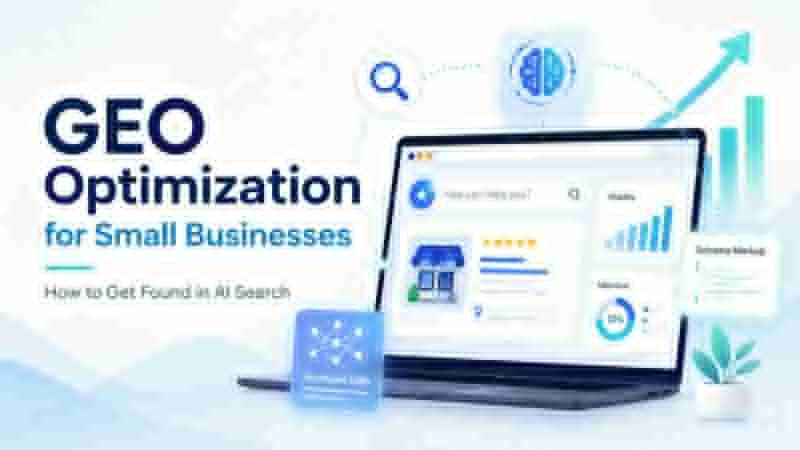
Search is changing quickly.
Customers are no longer relying only on traditional Google results. They are increasingly asking tools like ChatGPT, Google AI Overviews, Gemini, Perplexity, and other AI-powered search platforms for recommendations, comparisons, and answers.
For small businesses, this creates a new opportunity.
Generative Engine Optimization, or GEO, helps make your website easier for AI search engines to understand, trust, and potentially reference in their answers.
What Is GEO Optimization?
GEO stands for Generative Engine Optimization.
It is the process of improving your website so AI-powered search systems can better understand your business, products, services, expertise, and content.
Traditional SEO focuses heavily on ranking web pages in search engine results. GEO expands that strategy by helping your information become useful to generative AI systems that produce direct answers for users.
For example, someone may ask:
- What is the best accounting company for a small business?
- Which digital marketing agency should I hire?
- What is the best software for improving AI search visibility?
- Which local company offers this service near me?
GEO helps increase the chances that your business is understood as a relevant source for these types of queries.
Why GEO Matters for Small Businesses
Large brands often have strong authority, thousands of backlinks, and massive marketing budgets.
AI search creates another discovery channel where smaller companies can compete by providing structured, useful, trustworthy information.
1. Reach Customers Using AI Search
More people are using AI assistants to research products, services, and companies.
If your website clearly explains what your business does, who it serves, where it operates, and why customers should trust it, AI systems have more useful information to work with.
This can create additional visibility beyond conventional Google rankings.
2. Build Stronger Brand Visibility
A customer may discover your company before ever clicking a traditional search result.
AI-generated answers can introduce users to companies, products, tools, and resources while they are still researching their options. That means GEO is not only about traffic; it can also contribute to brand discovery and awareness.
3. Improve Website Content
Many GEO best practices also improve the experience for real visitors.
Good GEO content normally includes:
- Clear answers to common questions
- Well-structured headings
- Accurate business information
- Helpful service descriptions
- Frequently asked questions
- Relevant structured data
- Strong internal linking
- Author and company information
These improvements make your website easier to understand for both users and search engines.
GEO vs Traditional SEO
SEO and GEO should not be treated as competing strategies. They work together.
Traditional SEO helps your pages appear in search engines such as Google. GEO focuses more heavily on making your content understandable and useful for generative AI systems.
A strong digital visibility strategy should therefore consider SEO + AEO + GEO.
SEO helps improve traditional organic search visibility. Answer Engine Optimization, or AEO, helps structure content around direct answers. GEO helps prepare your content for AI-generated search experiences.
How Small Businesses Can Improve GEO
You do not need to completely rebuild your website. Start with the pages that matter most to your business.
Clearly Explain Your Business
Your homepage and service pages should immediately explain what you offer, who you serve, where you operate, what makes your business different, and how customers can contact or buy from you.
Avoid vague marketing language when a direct explanation would be more useful.
Answer Real Customer Questions
Create content around questions potential customers actually ask, including pricing, process, timelines, results, locations, requirements, comparisons, and common problems.
Useful answers give AI systems more context about your expertise.
Add Structured Data
Schema markup helps machines understand the meaning of information on your website.
Depending on your business, relevant schema can include Organization, LocalBusiness, Product, Service, Article, FAQ, Person, and Breadcrumb.
Correct structured data can make your website easier for search platforms to interpret.
Strengthen Trust Signals
AI search systems increasingly need reliable sources. Your website should therefore include clear signals about who is behind the content.
Consider adding a detailed About page, author information, company information, contact details, customer testimonials, case studies, original experience or research, and regularly updated information.
You can also review Aeoora’s features to see the types of AI-search and technical signals worth checking.
GEO Is an Opportunity, Not a Replacement for SEO
Businesses should not abandon traditional SEO because AI search is growing.
Google search, maps, local SEO, backlinks, technical SEO, and quality content remain important. GEO should be treated as another layer of optimization.
Small businesses that prepare early may have an advantage as customers increasingly use AI platforms to research purchasing decisions.
Start Checking Your AI Search Readiness
The first step is understanding whether your website is properly structured for AI-driven discovery.
A GEO audit can help identify problems with AI crawler accessibility, website structure, schema markup, answer-friendly content, AI visibility signals, technical SEO, entity information, and content clarity.
Aeoora helps businesses evaluate and improve their website for SEO, AEO, GEO, and emerging AI search experiences. You can also explore the Aeoora tools to start assessing your site’s readiness.
Final Thoughts
GEO optimization is becoming an increasingly important part of digital marketing.
For small businesses, the opportunity is straightforward: make your website easier for AI systems to understand and easier for customers to trust.
You do not need hundreds of pages or a massive marketing budget. Start by providing clear information, answering customer questions, improving structured data, strengthening trust signals, and maintaining technically accessible content.
The businesses that make these improvements today will be better prepared as AI-powered search becomes a larger part of how customers discover companies online.